
AI disclosure is becoming part of the production process across the European Union.
On 2 August 2026, Article 50 of the EU AI Act starts to apply. It covers several distinct situations: people interacting directly with AI, machine readable marking of synthetic outputs, emotion recognition and biometric categorisation, deepfakes, and some AI generated text on matters of public interest.
The European Commission published detailed guidance on 20 July and updated its supporting pages at the end of the month. On 31 July, it said about 190 organisations had signed the accompanying Code of Practice. The code is voluntary. The transparency duties in Article 50 are legal obligations.
For businesses and creatives, the immediate task is to understand which role they hold and where a clear disclosure or a proper review process is required.
The roles
The provider and the user have different jobs
The Act separates providers from deployers.
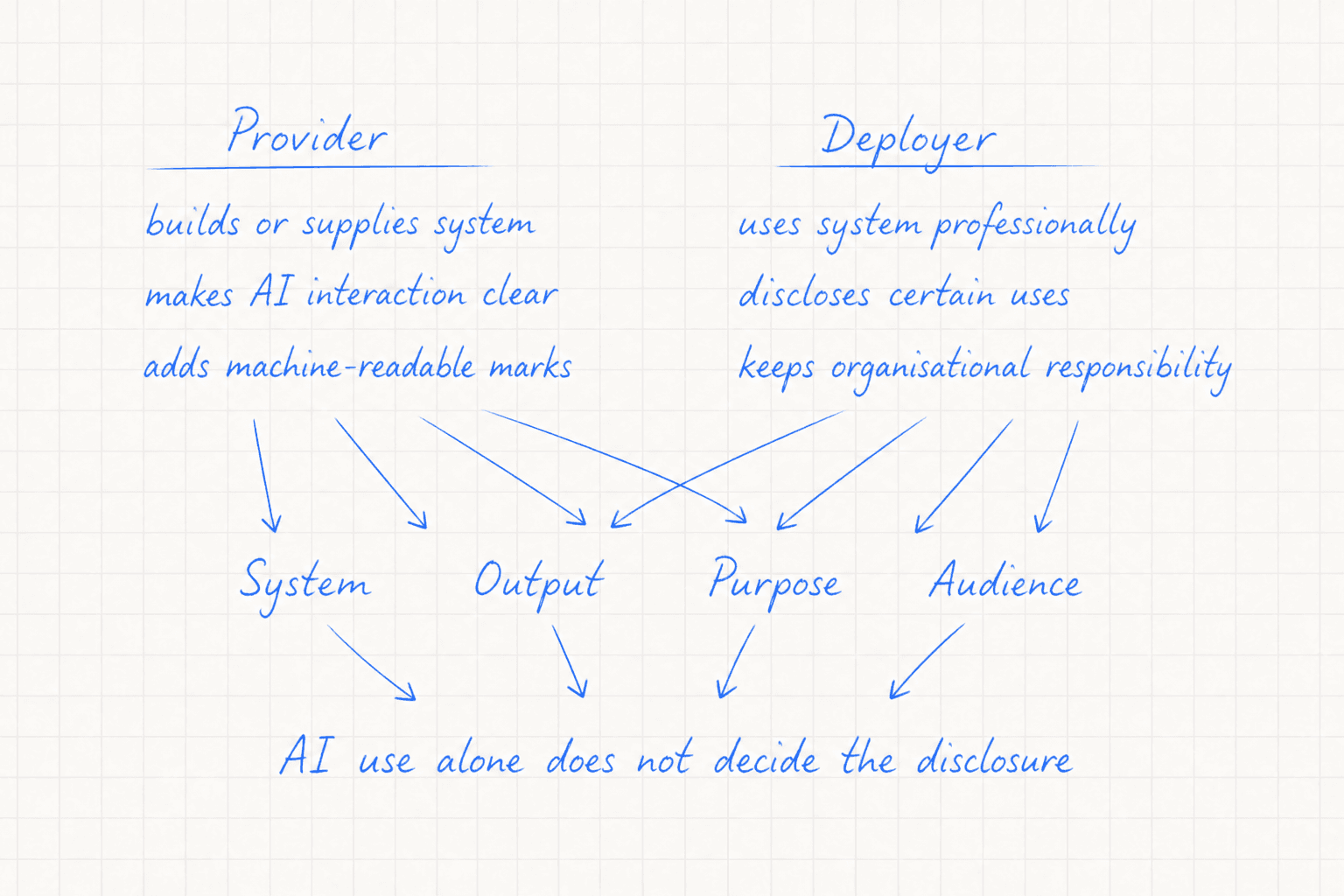
A provider develops an AI system, or has one developed, then places it on the EU market or puts it into service under its own name. Providers of systems that interact directly with people must make the AI interaction clear unless it is already obvious. Providers of generative systems must also add machine readable marks that allow synthetic audio, images, video and text to be detected.
A deployer uses an AI system professionally under its authority. This can include a business, an agency, a studio or a freelancer earning regular income from the work. The Commission’s guidance says employees and contractors working under an organisation’s responsibility are not separate deployers. Responsibility stays with the organisation using the system.
Deployers have their own duties. They must disclose deepfakes, inform people when emotion recognition or biometric categorisation is being used, and label certain AI generated or manipulated text published to inform the public on matters of public interest.
Article 50 treats each use of AI according to the system, the output, its purpose and the audience that sees it. The presence of AI alone does not determine the disclosure.
Two handwritten columns distinguish provider and deployer duties, with arrows to the system, output, purpose and audience that shape the disclosure decision.
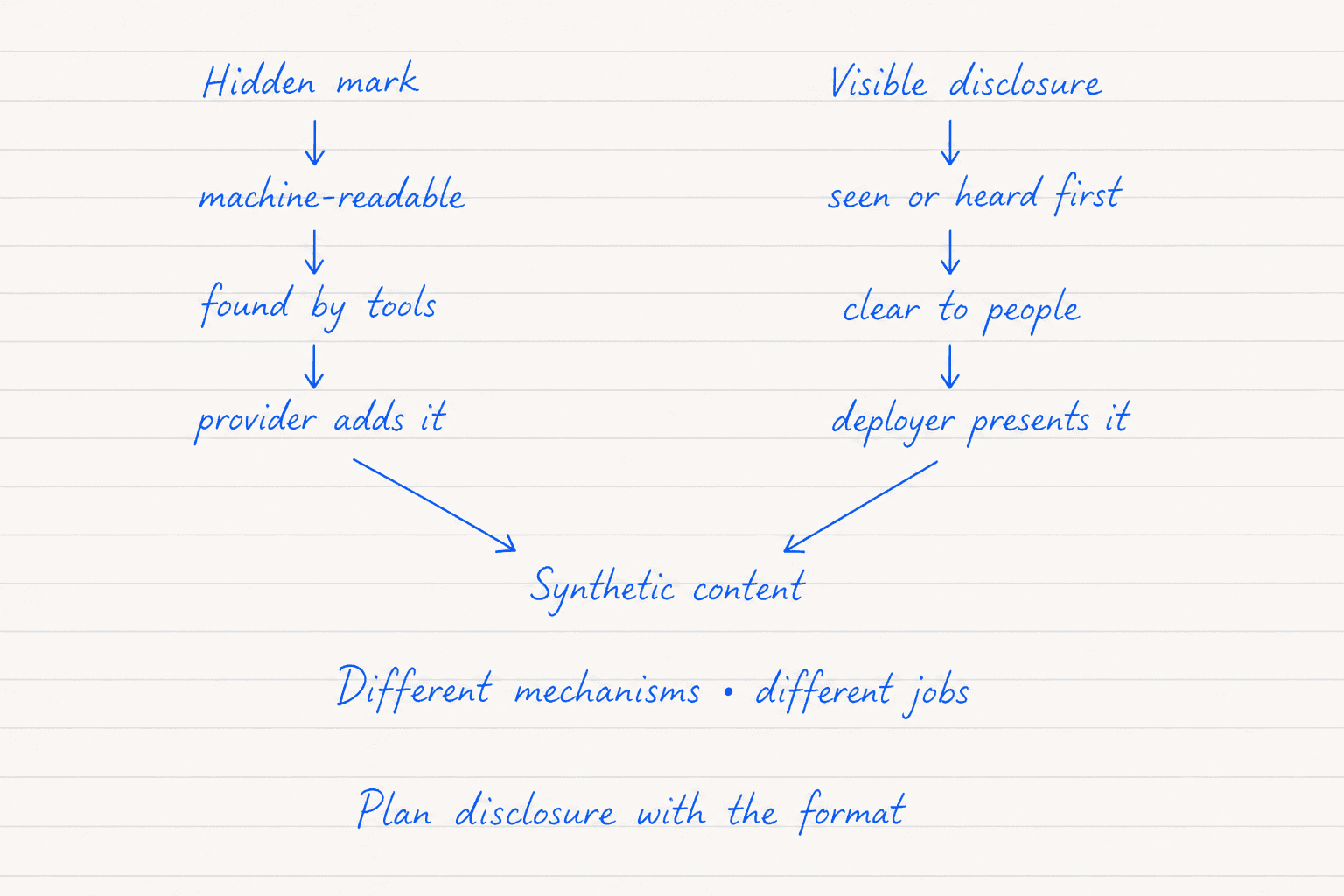
The review
Human review has to reach the substance
The rules for text are narrower than a universal label on AI assisted writing.
They apply when AI generated or manipulated text is published to inform the public on a matter of public interest. The Commission’s examples include politics, public services, health, safety, the environment, and economic, financial, scientific or cultural developments that may be part of public debate.
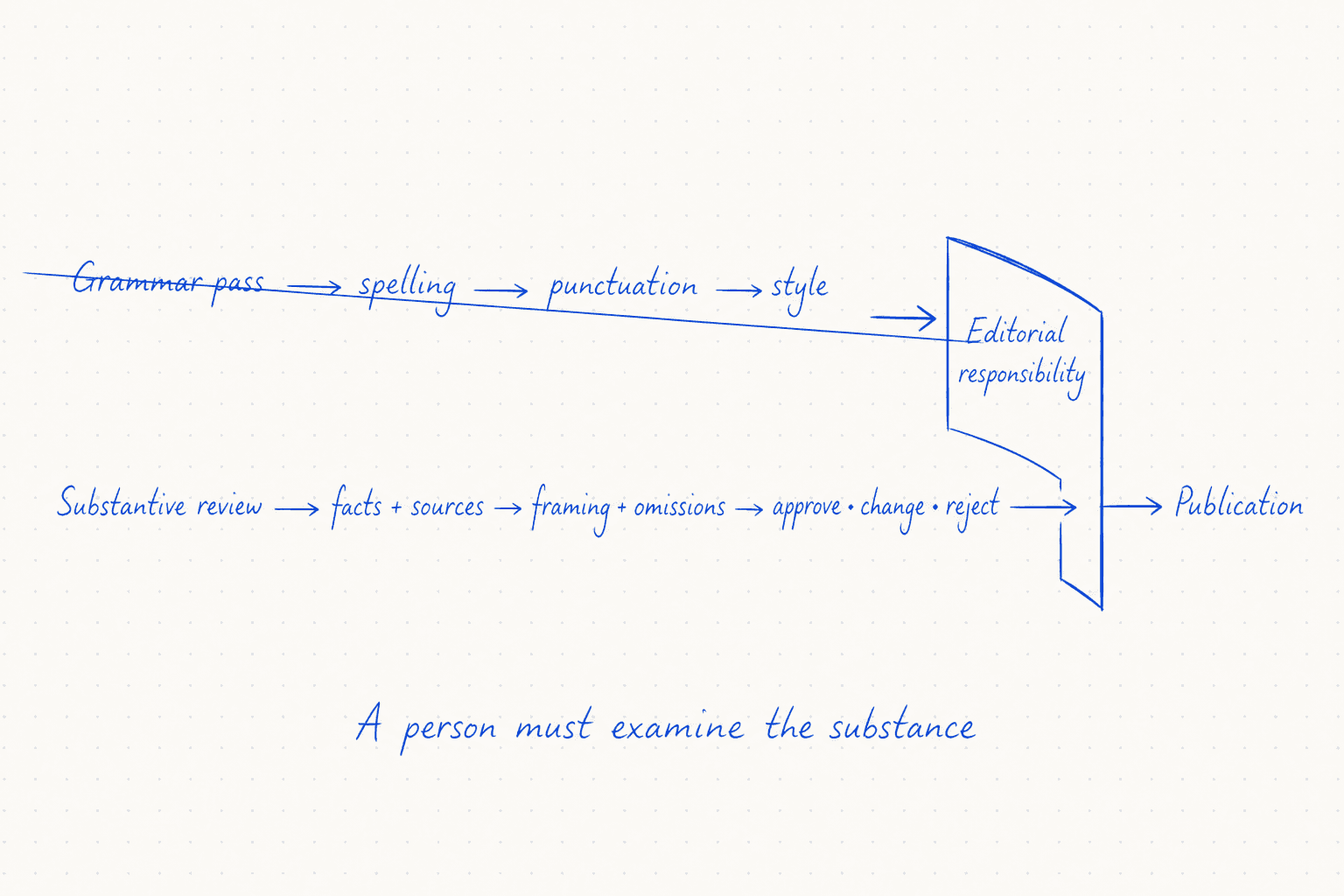
There is an exemption where the text has undergone human review or editorial control and a person or organisation holds editorial responsibility for the publication.
The standard for review is meaningful. The Commission describes a deliberate examination of the substance by someone with relevant knowledge and professional expertise. An editor must be able to approve, change or reject the content, check facts and assess the sources. A spelling or grammar pass does not meet that standard.
That standard has value beyond compliance. If nobody can name the person who checked the claims, challenged the framing and accepted responsibility for publication, the workflow is unfinished.
A grammar-only route is stopped before editorial responsibility, while a substantive review of facts, sources, framing and omissions passes through to publication.
The practical record
Build the record before you need the label
A small team can begin with a reliable record of how it uses AI.
Start with five questions:
- Where does a customer, employee or audience member interact directly with AI?
- Which published assets contain synthetic or materially manipulated audio, images or video?
- Could any of that work resemble a real person, place, object or event closely enough to appear authentic?
- Which public interest text uses AI, and who reviews its substance before publication?
- Where will the disclosure appear so that people encounter it clearly and accessibly?
A five-question handwritten production record is connected to retained sources, the AI tool, human changes, a named reviewer and final approval.
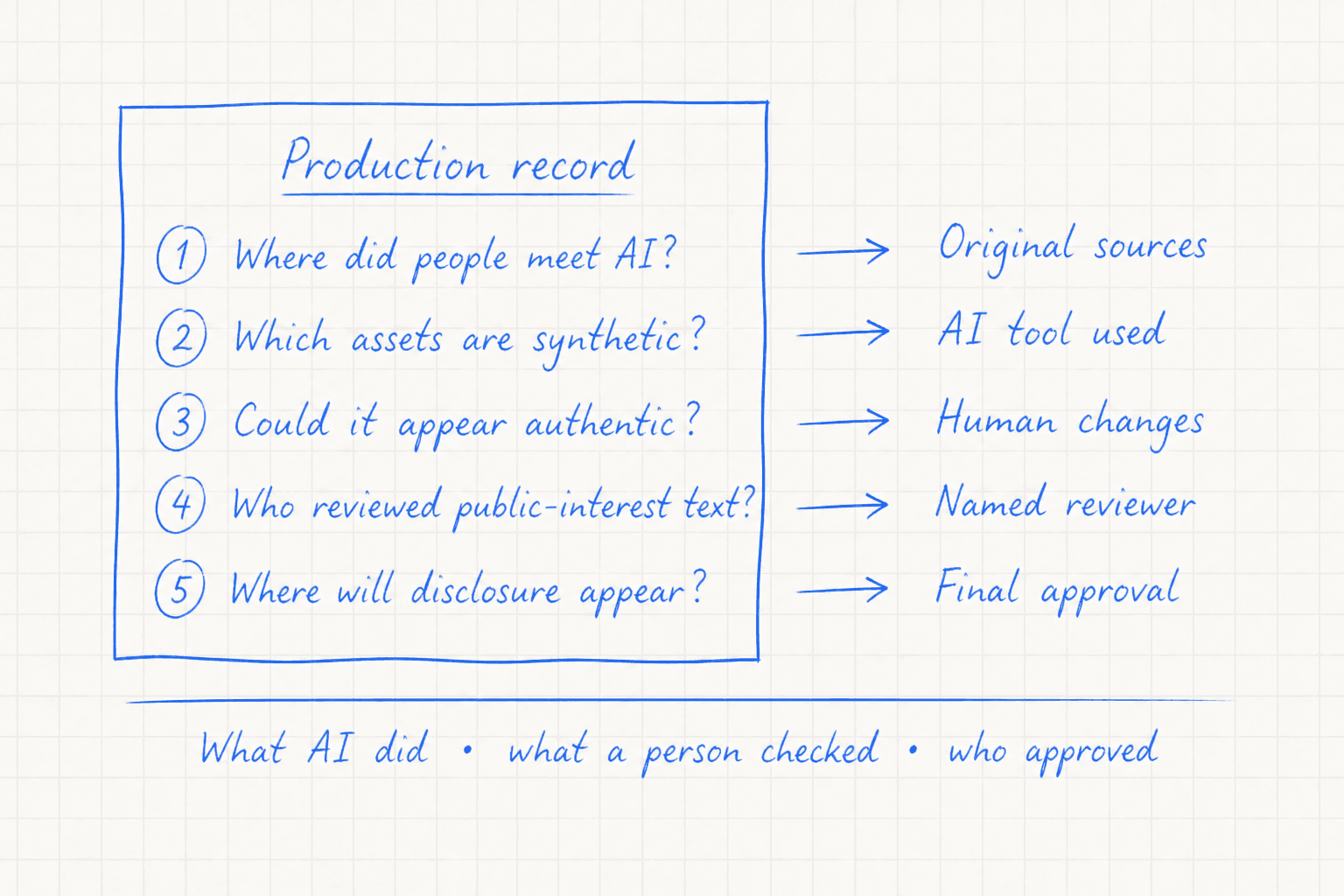
Keep the original sources, the AI tool used, the changes made by a person, the name of the reviewer and the final approval. Preserve any provenance metadata supplied by the tool or platform instead of stripping it during export.
This record makes the questions visible early enough to act on them. Some cases will still need legal judgement.
For work that may fall within Article 50, check the current Commission guidance and take qualified legal advice on your specific circumstances.
A production record should show what AI did, what a person checked and who approved the work.
Checked sources
Read the original reporting.
- Strong backing for the Code of Practice on Transparency of AI-generated ContentEuropean Commission
- Article 50: Transparency obligations for providers and deployers of certain AI systemsEuropean Commission AI Act Service Desk
- Transparency obligations under Article 50 of the AI ActEuropean Commission
- Guidelines on transparency obligations for providers and deployers of certain AI systemsEuropean Commission