
Qwen has released Qwen3.8-Max, a 2.4 trillion-parameter model that activates 95 billion parameters for each token. It accepts text and images, supports a context window of up to one million tokens, and connects with tools including Codex, Claude Code, Qwen Code, Qoder and OpenClaw through OpenAI-compatible and Anthropic-compatible interfaces.
Those specifications make it a credible option for document-heavy research, coding and longer agent workflows. Qwen has also trained the model for sustained autonomous work, with published examples covering a coding project lasting more than ten days, a 125-hour research reproduction and a 24-hour competition entry.
The results
The benchmark results are strong, although they are mixed
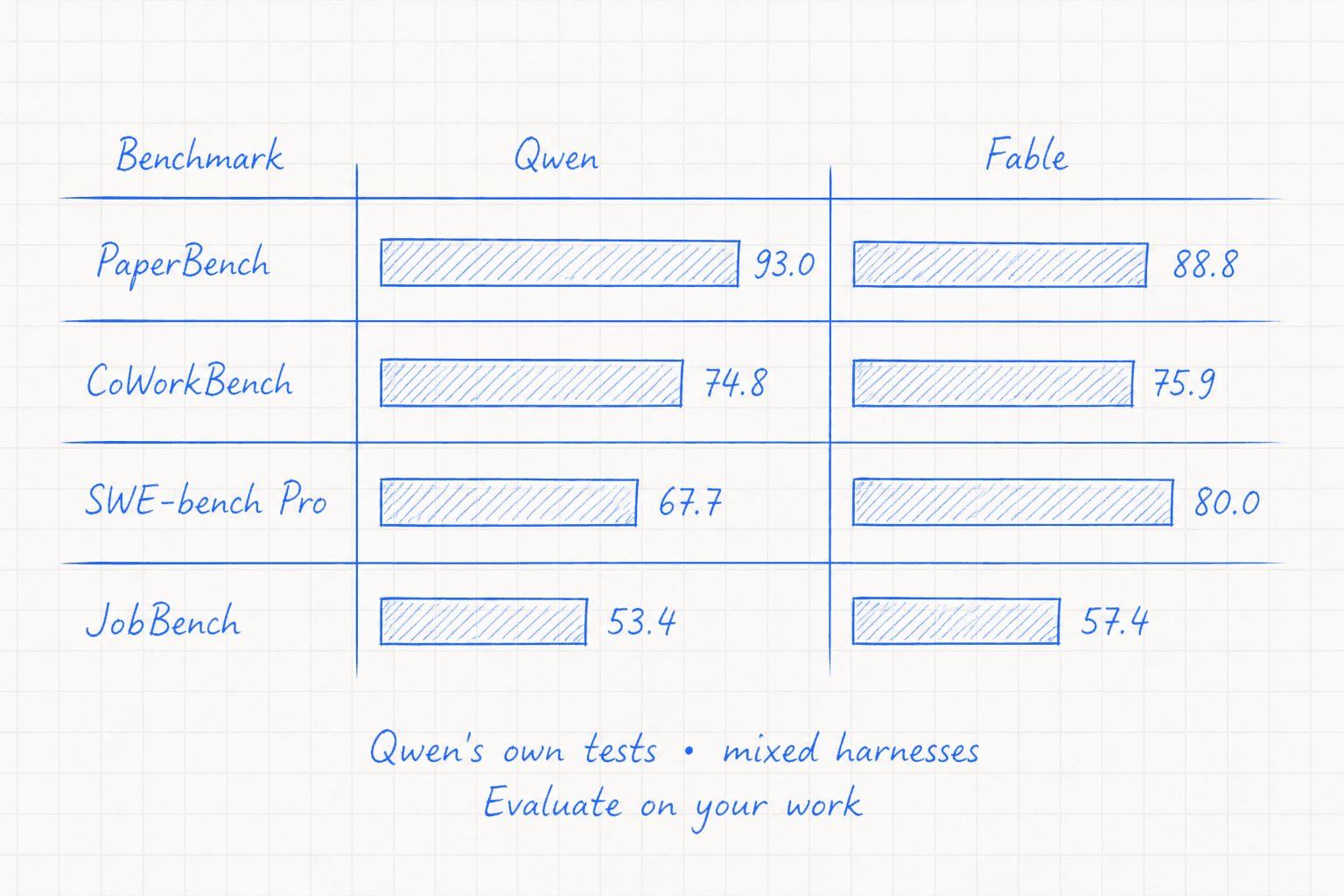
Qwen’s own benchmark table places Qwen3.8-Max close to several leading models. It reports a score of 93.0 on PaperBench, compared with 88.8 for Fable 5, while CoWorkBench is almost level at 74.8 against 75.9.
There are still tasks where the gap is clearer. Qwen reports 67.7 on SWE-bench Pro compared with Fable 5’s 80.0, and 53.4 on JobBench compared with 57.4.
The figures come from Qwen’s testing, with different harnesses and some internally run evaluations. They support putting the model through a serious test, while any buying decision still needs evidence from the documents, processes and tools an organisation actually uses.
A handwritten comparison gives Qwen and Fable scores for PaperBench, CoWorkBench, SWE-bench Pro and JobBench, alongside a warning that the figures come from Qwen's own mixed-harness tests.
The access
The $6 price needs some explanation
QwenCloud currently offers qwen3.8-max-preview through its Token Plan. The entry-level personal plan starts at a promotional price of $6 a month, with Standard at $18 and Pro at $68. The preview also receives a temporary credit benefit that reduces how quickly it consumes plan allowances.
That makes Qwen3.8-Max inexpensive to try. A direct input and output comparison with Claude Sonnet 5 is not available yet because Qwen has not published a standard pay as you go, per million token rate for this specific preview model.
Anthropic currently lists Sonnet 5 at an introductory $2 per million input tokens and $10 per million output tokens until 31 August 2026. Its regular pricing will then become $3 and $15 respectively.
Older prices published for Qwen3-Max belong to a different model and should not be applied to Qwen3.8-Max. For now, the accurate claim is that Qwen3.8-Max offers unusually low-cost preview access. Its longer-term API economics remain unknown.
The comparison
What should a business test?
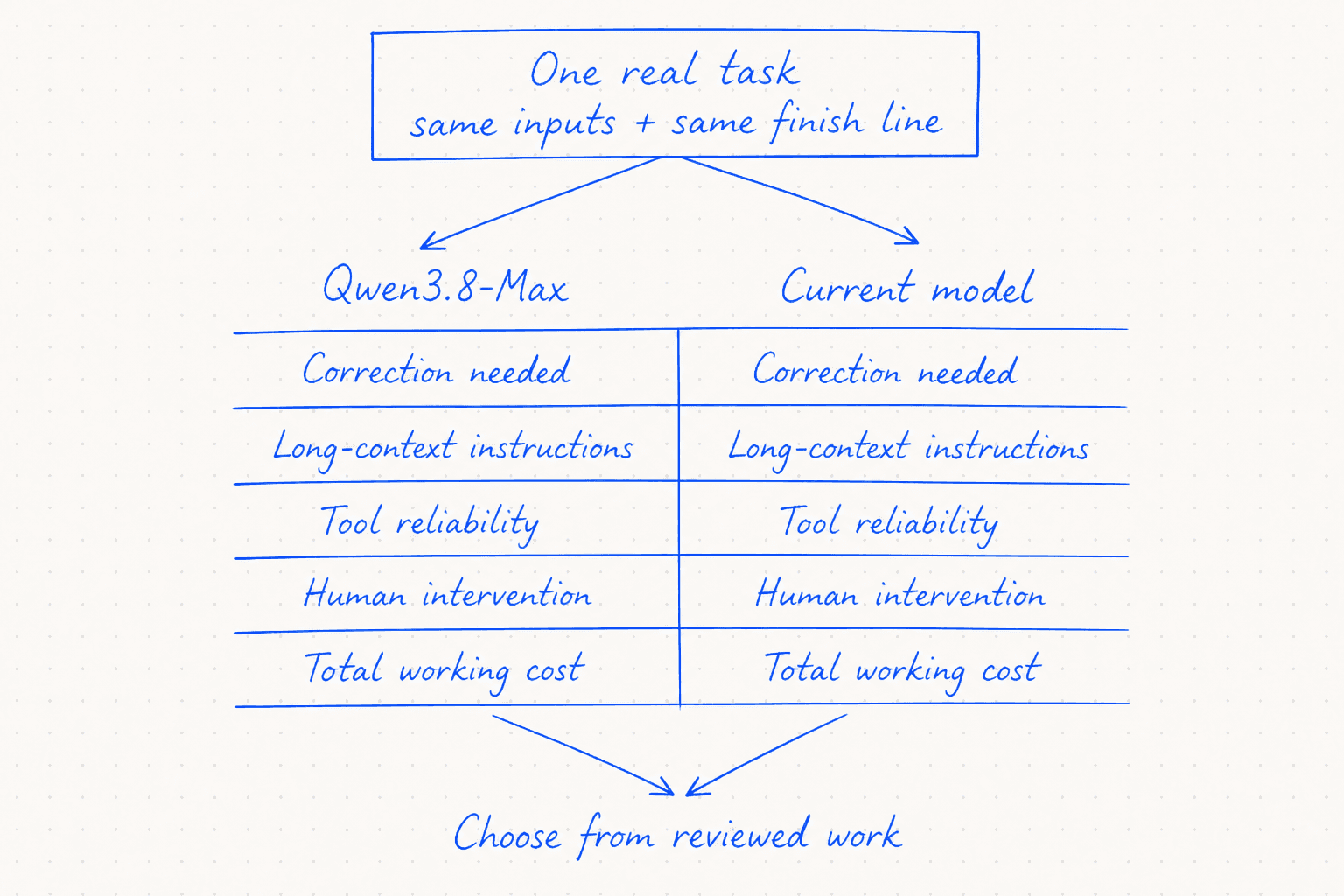
A useful comparison starts with one piece of real work: a research brief, a document analysis or a tool-assisted process that the team already understands.
Run the same task through Qwen3.8-Max and the organisation’s current model. Record how much correction each answer needs, whether instructions survive a long context, how reliably tools are called and how often someone has to intervene.
The one-million-token context window could be useful for large document collections, although putting more information into the model does not guarantee a better answer. Structure, permissions and review still determine whether the result can be trusted.
Qwen says it plans to release the model’s weights next week. If that happens, organisations interested in operating models within their own infrastructure will have another route to investigate. The licence, deployment requirements and final files should be reviewed once they are actually available.
Qwen3.8-Max combines large context, multimodal input, agent support and a remarkably accessible preview plan. The next question is how consistently it performs on real work, followed by what it costs once ordinary API pricing arrives.
One real task with the same inputs and finish line is run through Qwen3.8-Max and the current model, comparing corrections, long-context instructions, tool reliability, human intervention and total working cost.
Checked sources